Category: Uncategorized

  • How do you iron on interfacing before sewing? Beginners

    Interfacing is a fabric that is added when sewing garments. To help stiffen and support areas of the garment such as:

    • Cuffs
    • Waistbands
    • Collars
    • Neck facing

    Different Types of Interfacing

    Interfacing comes in different thicknesses, that can be used depending on the style of garment. For example heavy weight interfacing would work better for a winter coat and light weight for making summer dresses. There are two types of interfacing they are:

    • Iron-on Interfacing
    • Stitch-in Interfacing

    Top Tips for Interfacing:

    • When sewing I recommend using iron-on interfacing, as it does not move when sewing the garment.
    • Light-weight interfacing can be used for most garments, when dressmaking.
    • Instead of using heavy interfacing for heavy garments and bags. A few layers of calico can work better, to stiffen these items.

    How to Attach Iron On Interfacing Sewing

    Preparation:

    1. Cut your interfacing: Use your pattern piece as a guide to cut the interfacing to the exact shape you need. Aim for a slightly smaller size than the fabric piece to avoid excess glue seeping onto your ironing board.
    2. Set your iron: Refer to the care label on your fabric to determine the appropriate heat setting. Most inter-facings work well with a medium heat setting. However, it’s always recommended to test a small scrap of interfacing on the fabric beforehand to ensure it doesn’t scorch or melt.
    3. Prepare your pressing cloth: Use a clean, press cloth made from a thin, heat-resistant fabric like cotton or muslin. This helps protect your fabric and distributes heat evenly.

    Ironing:

    1. Place the fabric: Lay your fabric flat on the ironing board with the wrong side facing up.
    2. Position the interfacing: Place the interfacing on top of the fabric, ensuring the adhesive side (often rougher side) faces down directly onto the wrong side of your fabric.
    3. Press with the iron: Gently press the iron down firmly for 10-15 seconds on each section. Lift the iron straight up instead of sliding it to avoid shifting the fabric and interfacing.
    4. Repeat and check: Work your way across the entire piece, overlapping sections slightly to ensure complete adhesion. After pressing all sections, gently lift a corner of the interfacing to check if it’s securely bonded. If not, repeat pressing in that area.
    5. Cool and check again: Allow the fabric to cool completely before handling. Once cool, try lifting a corner of the interfacing again to ensure a secure bond.

    Additional tips:

    • Use a damp press cloth for heavier fabrics or those requiring more heat. Simply dampen the cloth, wring out excess water, and use it as instructed above.
    • Don’t use steam: Steam can reactivate the adhesive and cause the interfacing to shift.

    By following these steps, you can successfully iron on interfacing to your fabric and achieve a professional-looking finish in your sewing projects.

    For more sewing tips subscribe below:

  • When to Backstitch, Learn to Use Sewing Machine

    Modern sewing machines usually come with a switch that makes the machine stitch backwards.

    As a beginner it can be tempting to back-stitch at the start and end of every line. Worrying that your sewing will come undone. If you are doing alot of sewing, doing this will slow you down and is not necessary. Instead backstitch should only be used on stress seams.

    What are Stress Seams?

    A stress seam is a seam that gets pulled a lot, such as the edges of a patch pocket, zippers and openings of bags. This seam will need to reinforcing to stop it breaking. You can do this by stitch forwards and backwards over it few times.

    How to Backstitch on Sewing Machine

    Most domestic sewing machines come with a switch, that when held down makes the sewing machine stitch backwards. Check your instruction manual for your setting.

    • To backstitch, press the switch so the machine starts to sew backwards.
    • Sews backwards and forwards, 3-4 stitches about 3-4 times to strengthen the stress seam.

    For more sewing tips subscribe below:

  • How to Sew Hook and Eye

    A hook and eye can be stitched onto a garment, such as blouse or dress. It is fastening that is often used to fasten necks and waistband closed.

    Sew on Hook and Eye Tip Tips

    • Sew on the hook and eye using the small round holes at the base of the pieces.
    • The hook and eye should be stitched on horizontally, close to the edge of the garment fastening.
    • When sewing on the hook and eye, you may find it more comfortable for the hook to face outwards. So it does not catch on your skin.
    • If you are closing a large gap using hook and eyes. Try using sew on hook and eye tape, that has multiple fastenings attached in a row.

    For more sewing tips subscribe below:
  • Hand Stitches for Making Clothes, Beginners Guide

    When sewing clothes together, sometimes sewers will use hand-stitch to stitch the pieces together first.This can make it easier to check all the pieces are matched correctly, before machine sewing them.

    See below videos and top-tips on how to hand-sew:

    How to Knot Thread into Fabric

    How to Stitch Running Stitch

    Running stitch also known as basting and tailor-tacking stitch. Can be used to loosely stitch fabric together. The video below will show you how to do this.

    How to Stitch Back-stitch

    How to Un-pick Thread

    Hand-stitching Clothes Together

    Hand-stitching is relaxing and you can’t hand-sew clothes together, without the use of a sewing machine. It does take longer, yet it is the most sustainable way to make clothes.

    To sew clothes together you only need to know two stitches.

    • Back-stitch – To sew seams and top stitch.
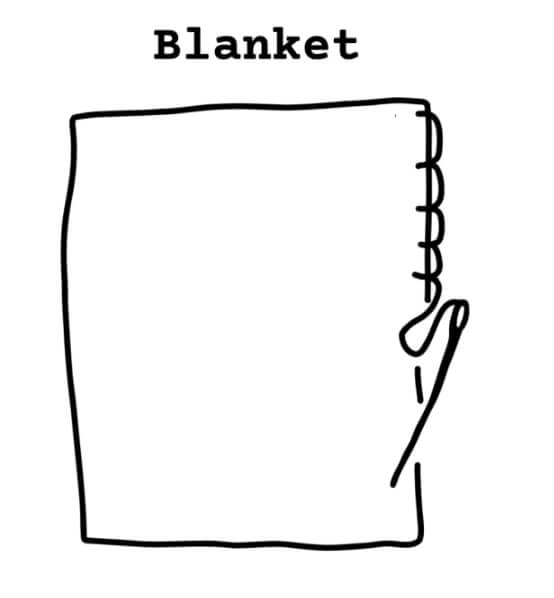
    • Blanket stitch – Over-locking edges of fabric.

    How to Back-stitch

    For a video demonstration see: How to Back-stitch.

    • To back stitch simply sew a stitch.
    • Then bring the needle up through the fabric.
    • At the end of where you want the next stitch to be.
    • Then re-enter the fabric through the end of the first stitch.
    • Keep repeating, until you have a line of stitches.

    How to Blanket-stitch

    For a video demonstration see: Blanket-stitch.

    • Sew a stitch, yet before pulling all the tread through create a loop.
    • Put the needle through the loop, before pulling tight.
    • This will make the thread wrap around the edge of the fabric.
    • Repeat this over and over again, until the edge of the fabric is sealed.

    For more sewing tips subscribe below:

  • Stitching Stretchy Fabric, Seams Beginners Guide

    Stretchy clothes need to be sewn together differently, to non-stretchy woven fabrics.

    Stretchy fabrics if stitched with a standard straight stitch, when stretched the thread will snap and come undone. Learn more about, “Different types of stretch fabrics and stitches”.

    How to Stitch Stretchy Fabrics

    When sewing stretchy fabrics together use a zig-zag stitch. This type of stitching will not snap when the fabric is stretched, instead it will stretch with the fabric.

    • To zig-zag stitch stretchy fabric, set your machine to zig-zag stitch. This stitch can be used to sew seams and hems.
    • The stitch does not need to be very wide, experiment with the width and length of the stitching.
    • A thinner zig-zag stitch may look better when top stitching hems and bias binding.

    Stitching Stretchy Fabric On Sewing Machine

    A domestic sewing machine can be used to stitch zig-zag stitch. Yet if you have an overlocker machine they are ideal for sewing stretchy fabrics.

    • Overlocker machines seam and overlock the edges of stretchy fabric at the same time.
    • This machine will stitch the stretchy fabric together, whilst sealing the edge of the fabric.
    • Be sure to check your garment pattern before doing this, as you may need to make your seam allowance smaller. Using a seam allowance of 0.5cm.
    • Straight stitch may be used on areas of the garment that don’t stretch. Such as when top-stitching neck facing.

    What Needle to Use for Stitching Stretchy Fabric?

    When stitching stretch fabric it is better to change the sewing machine needle. To use a needle that is especially designed to sew stretchy fabric.

    • Use a ball point jersey needle to stitch stretchy fabrics.

    How to Sew Stretchy Garments, Top Tips

    Top tips for sewing stretchy garments.

    • No darts, stretchy clothes may not need darts.
    • No ease, tops of sleeves may not need gathering.
    • No interfacing, it may rip when it is stretched.
    • No facing, often bias binding is used instead of facing.

    Use a cover stitch machine to finish stretchy fabric garments. A cover stitch machine can be used to top stitch the hems and necklines on clothes made with stretchy fabric.

    For more sewing tips subscribe below:

  • Sewing Machine Feet, Beginners Guide

    Sewing machines come with many weird and wonderful feet. Yet you can sew most cushions, bags and clothes using just 3 x machine feet.

    List of Sewing Machine Feet

    Below are the top 3 x machine feet that a beginners needs, when to learning how to sew:

    • Straight stitch foot – This is the foot usually already on the machine, to use for straight stitch or general sewing.
    • The zig-zag stitch foot – This foot has a wider hole, for the needle to move when zig-zag stitching. It may have slightly pointed, curved edges.
    • Zipper foot for fitting zips – The zipper foot has a flat side with a hole, to allow the needle to stitch closer to the zip. It can be single or double edged.

    Note: The zig-zag machine stitch foot, can also be used for straight stitch.

    What Machine Feet for Sewing Machine

    As you get more confident with sewing and using your machine. You may finding using the extra machine feet below useful. For photographs of the machine feet see “Ultimate Guide Machine Feet”:

    • Button hole foot – For stitching button holes, to the size of your button.
    • Roll hem foot – Use when stitching small hems of circular, flared skirts.
    • Elastic sewing foot – Stretches and stitches on elastic bands to your fabric.
    • Couching foot – Can be used for shirring, attaching thin elastic threads.
    • Gathering foot – Used to create slight gathers in fabrics and ribbons.

    As an extra try purchasing a ruffling foot. I love this foot, it is very large and costs more than a standard gathering foot. Yet you can make nearly everything with a length of gathered fabric and big ruffles.

    Singer Outlet has a wide section of machine feet to purchase, see “Accessories Sewing Feet”.

    • The ruffles on the dresses below were made with a ruffling foot.

    For detailed advice on the types of machine feet fittings, on different types of sewing machines. See section in post on “Snap on or Screw“.

    For more sewing tips subscribe below:

  • Stitching Corners and Curves, Beginners Guide

    Learn how to sew corners and curves. See the handy tips below, to get your corners and curves looking great.

    How to Stitch Corners Sewing

    Stitch Corners Step by Step Guide

    • To get a sharp corner when stitching sew to the corner of the point.
    • Before turning the fabric lower the needle down in the fabric.
    • Once the needle is in the fabric, raise the machine foot.
    • The needle will hold the fabric in place, whilst still allowing it to pivot.
    • Turn the fabric to the new stitch-line, lower foot and carry on stitching. 

    How to Stitch Curves Sewing

    Stitching Curves Step by Step

    • When sewing curves take it slow.
    • Stitch a little, slowly, whilst gradually turning the fabric.
    • Focus where you need to be heading, the line the stitch should follow.
    • Chalking the stitch-line before sewing can help as a guide to follow.

    How to Cut Corners Sewing

    When sewing items such as cushions that have right angle corners, the corners need cutting to stop them being hard and bulky.

    Cutting Corners Step by Step

    • When the item inside out, cut diagonally across the corner at a 45 degree angle.
    • Cut across the seam allowance, as close to the stitching as possible, without cutting through it.
    • This will take away the bulk when the corner is turned the right way round.
    • To further sharpen the corner, use a blunt pencil to gently push out the corners.

    How to Snip Curves Sewing

    When sewing items that have curved seam, the seams need snipping so the edges fold flat.

    Snipping Curves Step by Step

    • The snip the seams allowance, leaving a gap of 1cm between snips.
    • Cut as close to the stitching as possible without cutting through it.

    Top Stitch Curves

    This is a trick that helps neck facing lie straight, once you have snipped your curve and folded it over.

    • Ensure that you stitch the snipped seam allowance to the back facing.
    • This is made easier by folding out the fabric, so it is facing upwards.
    • Then stitch a line close to the seam-line on the facing fabric, with the seam allowance tucked under.

    For more top sewing tips subscribe below:

  • How to get Straight Seams, Beginners Guide

    When sewing it is really important to sew straight seams. Seams that are not stitched straight, will make cushion, bags, clothes look wonky.

    How to Get Straight Seams

    The best way to get straight seams is to use a seam allowance marker and an iron.

    A seam allowance marker helps to create equal, straight seams. To create a straight seams watch video above and follow steps below:

    • Simply take a tape measure to measure and mark the seam allowance width on your sewing machine.
    • Measure seam allowance outwards to the right, from the needle on your machine.
    • Mark the seam allowance on the machine. By using a seam allowance magnet, that can be purchased for a few pounds, or attach a piece of tape.
    • When sewing, ensure the edge of your fabric lines up with the seam allowance guide. This will create even, straight seams.
    • For more tips see, “How to sew a straight line”.

    How to Sew Seams Beginners Top Tips

    • Use a seam allowance of 1.5cm for standard sewing.
    • Stretchy fabrics usually have a small seam allowance of 0.5cms.
    • Always check your pattern for the size of the correct seam allowance/
    • To get seams straight use a seam guide.
    • After sew your seams, they should be folded out and ironed flat.
    • Seams need to be flat when hemming skirts, trousers and sleeves. 

    For more sewing tips subscribe below:

  • What are Notches in Sewing?

    Notches are small triangles cut into the edge of fabric.

    The notches act like instructions when sewing. So you know which pieces of fabric to stitch together. A bit like the pieces in a jigsaw the notches may show you where a sleeve needs to attached to a top.

    Notches on Dressmaking Patterns

    Dressmaking patterns, have notches marked onto them, often as small diamond shapes. The notch marks may be singular or double.

    • Single notches are used for front garment pieces.
    • Double are used for back garment pieces.

    Notches in Sewing Sleeves

    Sleeve patterns have single and double notch marks along the top:

    • Single notches show where to attach the front of the sleeve.
    • Double notches show where to attach the back of the sleeve.

    Notching Seams and Hems

    To mark a notch on your fabric, make a small nip using scissors. Sometimes dressmakers cut notches as triangles sticking out of the fabric. Yet triangular notches will get cut off by the over-locker, so best to mark them as nips instead.

    It can be useful to also notch where your seam allowance and hem allowance is, to help you when sewing.

    For latest sewing tips subscribe below:

  • Setting up for Sewing Beginners Guide

    To start sewing on a sewing machine, it should as simple as, threading the machine. Putting your fabric under the machine foot and then placing your foot on the peddle to start sewing. 

    Yet doing this can make your machine more stop working and threads to become tangled. See below for tips about how to start and end sewing correctly.

    How to Start and End Sewing

    To help your machine have less chance of getting tangled, follow this step by step process before sewing.

    • Thread your machine correctly, ensure needle is raised.
    • Put your fabric into the machine under the lowered foot.
    • Hold the end of the top thread and turn the handle forward.
    • To lower and raise the needle once, in and out of the fabric.
    • Once the needle is up, gently tug the top thread.
    • So the bottom thread comes-up through the fabric.
    • Gentle pull both the top thread and bottom thread.
    • Pull them out to the length of approx 10cms.
    • Lift the machine foot and slide both threads to the back of the machine.
    • Under the machine foot, the foot may have a little gap to do this. 
    • Then again lower the needle into the fabric, leave it in this time.
    • Then start sewing, simple! 

    For more sewing tips subscribe below: